Winemakers
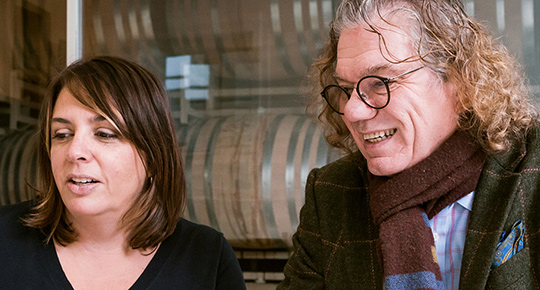
Ernst Loosen was born into a great tradition of German winemaking. Since the Dr. Loosen estate on the Mosel River has been in his family for over 200 years, you’d think it only natural for Ernst to take up the family legacy as a profession. The truth is, though, that as a youngster Ernst was more fascinated by the numerous Roman ruins in the area than by the family vineyards. So he went off to college to study archaeology.
In the mid-’80s, however, Ernst was faced with a decision. His father was ready to turn the estate over to the next generation and none of his brothers or sisters was old enough or interested enough to take it on. We could be melodramatic and say that it was time for Ernst to face his destiny, but really it was more of an odd-man-out decision. Happily, as it turns out, Ernst found his true calling among the broken slate of his family’s vineyards rather than the hewn stones of an old Roman ruin.
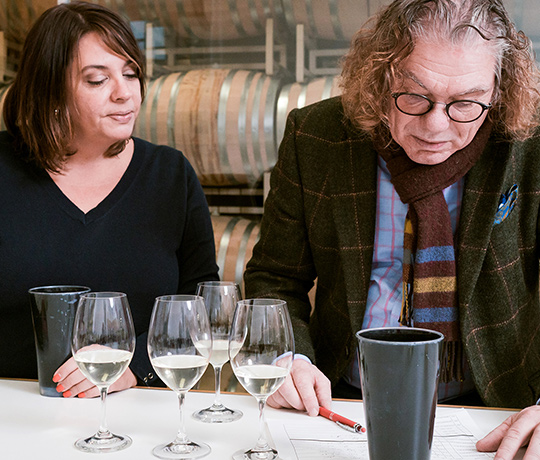
Ernst dove into winemaking with his customary fervor. He completed studies at Germany’s renowned winemaking school in Geisenheim and then launched into a selfdirected review of the great wines of the world. He traveled to Austria, to Burgundy and Alsace, even to California. He went wherever great wine was being made, seeking out the best winemakers to find out what they had in common. What he discovered was that they all share a dedication to producing intense, concentrated wines that boldly proclaim their heritage. They also have a worldly outlook that allows them to maintain respect for tradition while tempering it with reason. This gives them the freedom to acknowledge that not all traditions deserve to be doggedly observed, and allows judicious use of modern winemaking techniques when it will improve quality.
It is this global market view to which Ernst heartily ascribes. It is a philosophy that balances the old with the new. It is a way of thinking that has allowed him to move beyond the easy and familiar, the tried and not necessarily so true, to make wines that stand out as truly distinctive and world-class.
“I have learned from Ernst Loosen, our German winemaking partner on Eroica Riesling, how to protect fruit purity and produce fresh, fruit-driven Rieslings.” - Bob Bertheau
Bob Bertheau joined Chateau Ste. Michelle in June 2003 as its winemaker of white wines, after 16 years of winemaking in Sonoma County, California. He was promoted to Chateau Ste. Michelle head winemaker in August 2004.
“I am amazed at the difference in grape growing in eastern Washington,” says Bob. “We have such unique growing conditions here: low rainfall, extra sunshine during the growing season, cooler days at the end of harvest for longer hang time, and a pioneer spirit of the local growers and winemakers. These conditions help us grow world-class fruit and make wines of character, complexity and quality.”
Bob has maintained Chateau Ste. Michelle’s legacy of crafting awarding-winning Chardonnay, Riesling, Merlot and Cabernet Sauvignon, while putting his own signature on the wines. “My goal is to use winemaking to bring out the natural varietal character and the regional expression in the wines,” says Bob. “I have learned from Ernst Loosen, our German winemaking partner on Eroica Riesling, how to protect fruit purity and produce fresh, fruit-driven Rieslings.
"For Chardonnay,” Bob adds, “I’m using more Burgundian yeasts and have changed our lees stirring and oak regimes for better integration of oak flavors and more harmonious, soft Chardonnays. Washington’s red varieties have great structure and intense fruit. My goal with the reds is to harness the tannins for more accessible red wines from Chateau Ste. Michelle.” Prior to joining Chateau Ste. Michelle, Bob made his mark at Hambrecht Vineyards and Wineries with their Belvedere and Bradford Mountain labels. In his formative years out of UC Davis, he gained valuable mentoring from such renowned winemakers as Bob Sessions at Hanzell Vineyards and David Ramey at Chalk Hill. Wanting to gain an even broader experience with a wide variety of grapes and viticulture areas, Bob also worked at Gallo of Sonoma for five years, helping to bring a smaller winery mentality to the larger facility.
For Bob, the move to Chateau Ste. Michelle in 2003 was not only the chance to make wine for one of Washington’s most acclaimed wineries, it was also a chance to come home. He was born in Seattle, went to school in nearby Idaho, and has most of his family living in the Seattle area.
Bob has a degree in chemistry from Boise State University and an MS in food science and enology from University of California at Davis. Founded in 1934, Chateau Ste. Michelle pioneered vinifera grape growing in Washington state and has been producing classic European varietal wines under the Chateau Ste. Michelle label since 1967. The winery combines an ongoing dedication to research with a commitment to classic winemaking traditions.